
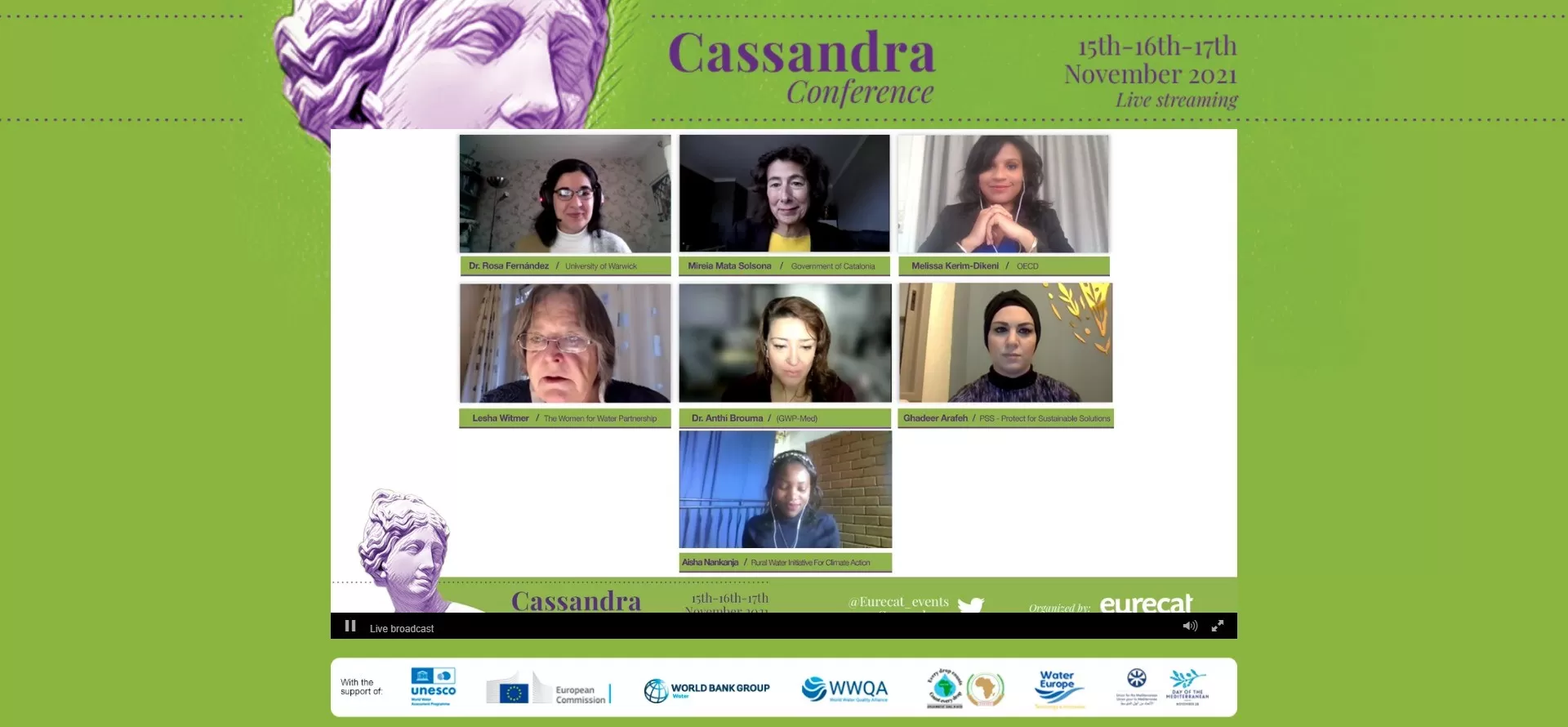
Climate change will further exacerbate poverty and lack of opportunities for women, who on average tend to be worse off in terms of poverty, education, health and restricted immediate access to and ownership of natural resources.
This was made evident today on the second day of the international Cassandra conference hosted by the Eurecat technology centre with a view to providing scientific and technological answers to help address the direct impact of climate change on health, migration, conflict and gender inequality across the Mediterranean.
“Women and girls are disproportionately harmed by the effects of climate change,” said Melissa Kerim-Dikeni, policy analyst at the OECD’s Water Governance and Circular Economy Unit. She noted a recent OECD report saying that “only seven OECD countries out of the 38 member states gathered gender-disaggregated data related to the environment and only 13 OECD countries look at gender aspects when drawing up environmental policies.” In her view “this is not good enough.”
“Women need to be consulted and take part in climate change initiatives,” argued Mireia Mata, the Secretary General for Equality in the Government of Catalonia. She added that they should be “equally represented in decision-making structures to allow them to input their unique and valuable perspectives and experience in climate change.”
Scientific and technological solutions to climate change challenges
Decisions about water quality are made on the basis of scientific knowledge in the field. However, “measuring water quality for people is not enough as also we need to engage them in the process,” pointed out Bernd M. Gawlik from the European Commission’s Joint Research Centre.
Bernd M. Gawlik was speaking during the event’s second panel looking at the Renaissance of the Mediterranean and where the forthcoming edition of ‘The Gateway to the Future of the Mediterranean’, jointly published by the European Commission and the Eurecat technology centre, was also presented.
This session underscored the importance of setting up a community of practice to roll out climate change measures for the future which gathers key actors from politics, science and the arts. It also set out the need to achieve an effective dialogue between science and the general public.
Likewise, Tebaldo Vinciguerra from the Human Development Dicastery at the Holy See stressed that we have to “investigate, promote and replicate good practices, inspiring real stories that work in Mediterranean cultures at a cross-border level” and also on new initiatives, strategies and projects “to engage religion, philosophy and anthropology from the outset.”
The conference additionally featured a panel in which the speakers unpacked and presented solutions in water, air quality, food production, transport, waste, energy, soils, mountains and deltas.
“Climate resilience entails a transformation of the socioeconomic system,” noted Carles Ibáñez, scientific director of the Climate Resilience Centre and Head of the Climate Change Department at Eurecat. “That means not only an energy transition but also a socio-ecological transition, a new way of producing what we need and a new way of living with a much lower environmental impact.”
Xavier Domingo, the director of Eurecat’s Applied Artificial Intelligence Unit, pointed out “the potential of digital technologies such as artificial intelligence and machine learning coupled with similar data-driven approaches to provide effective decision support for adapting to and mitigating the impacts of climate change in Europe and beyond.”


