
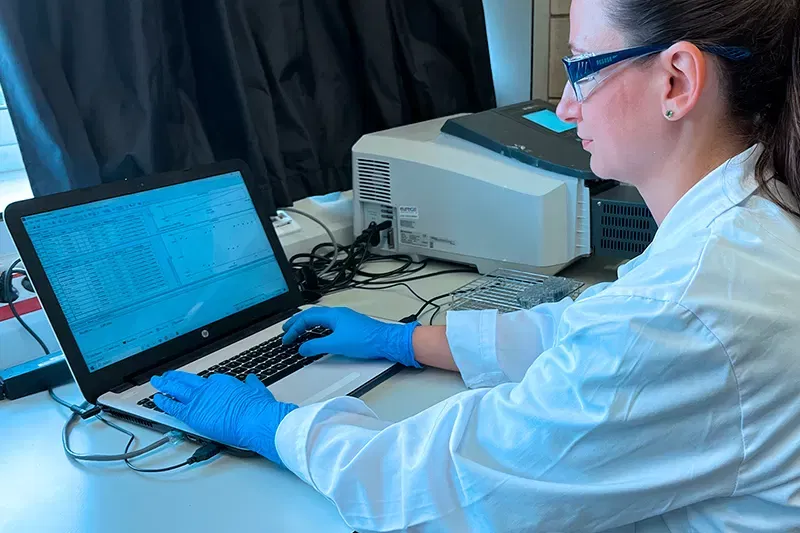
The scientific and technological transformation that society is undergoing requires more female talent across all fields of knowledge, from scientific leadership and applied research to technological development and business innovation. This is not only a matter of representation, but of strengthening our capacity to innovate by incorporating a diversity of perspectives that generate more effective solutions aligned with real needs.
The International Day of Women and Girls in Science, celebrated every 11 February and promoted by the United Nations, invites us to highlight the contributions of women in science and technology, and underlines the need to reduce gender gaps.
At Eurecat, we join this commemoration as part of an ongoing work to strengthen female talent beyond a single date. Raising the visibility of women researchers and fostering STEM vocations is key to scientific development, business competitiveness and innovation with social impact.
Promoting STEM vocations
STEM disciplines (science, technology, engineering and mathematics) are drivers of advanced economies and central to the future labour market. However, the presence of women in these fields remains limited.
In 2023, only 28.6% of higher education students in STEM in Spain were women, a figure below the European average (32.2%). (European Commission, Education and Training Monitor 2023; Eurostat, 2024).
In the case of Catalonia, the data point to a similar scenario. In the 2022–2023 academic year, women represented approximately 20.98% of students on undergraduate STEM degrees. (Parliament of Catalonia, 2024). In the technology sector, women continue to be underrepresented. Despite some recent progress, they account for only around one third of the ICT workforce in Catalonia, and just 26.4% of specialist technology roles are held by women (2nd DonaTIC Women in ICT Barometer in Catalonia, 2024).
This deficit is not due to a lack of talent, but to cultural barriers, stereotypes and the absence of female role models in the early stages of education. For this reason, encouraging STEM vocations among girls and young women is essential to building a diverse and competitive innovation system.
Eurecat researchers in the classroom
Eurecat actively participates in initiatives that bring science and innovation closer to students and help spark scientific vocations. Among these highlights the #100tífiques event, promoted by the Barcelona Institute of Science and Technology (BIST) and the Catalan Foundation for Research and Innovation (FCRI), which connects women researchers with students of all ages.
As part of the 11F activities, Eurecat researchers also take part in talks, workshops and outreach activities in schools and high schools across the region, addressing topics such as artificial intelligence, climate resilience, sustainability, biotechnology, genomics and new water treatment technologies, among others, bringing applied research closer to students’ everyday reality. This year’s participants include Irene Jubany, Scientific Director for Sustainability; Encarna Escudero, from the Plastics and Composites Materials Unit; Laura Mayor, Violeta Vargas and Maia Montaña, from the Waste, Energy and Environmental Impact Unit; Laura Vinardell and Joana Díaz, from the Water, Air and Soils Unit; Natàlia Carmona, from the Technology Consultancy Department; Ashneet Khandpur Singh, from the IT and OT Security Unit; and Núria Canela and Lucía Tadeo, from the Omics Sciences Unit.
In the following video, you can meet some of these researchers and discover what motivated them to pursue a career in science and technology world, the changes they believe are needed to move towards greater equality in this field, and how we can inspire younger generations to take an interest in science.
Irene Jubany (Scientific Director for Sustainability)
“In the future, I would like it to be understood that teams made up of both men and women are far stronger.”
Lucía Tadeo (Omics Sciences)
“We need to show girls, from a very early age, that science is a completely accessible and exciting world in which there is a place for everyone.”
Natàlia Carmona (Technology Consultancy)
“Seeing that there were no girls taking technology subjects at my secondary school motivated me to break the barrier and move closer to this field.”
Laura Mayor (Waste, Energy and Environmental Impact)
“Thanks to my aunt and my teacher, I discovered that science was a deeply enriching and beautiful way of understanding the world.”
Beyond 11F
11F is an opportunity to launch initiatives and to reinforce a lasting commitment to equality and female talent. Raising the visibility of women researchers, fostering STEM vocations and incorporating a gender perspective into the world of research and technology increases innovation capacity, business competitiveness and the social relevance of R&D&I. The aim is to consolidate an inclusive, diverse and responsible model of science and technology, with tangible impact and a clear focus on excellence.


