
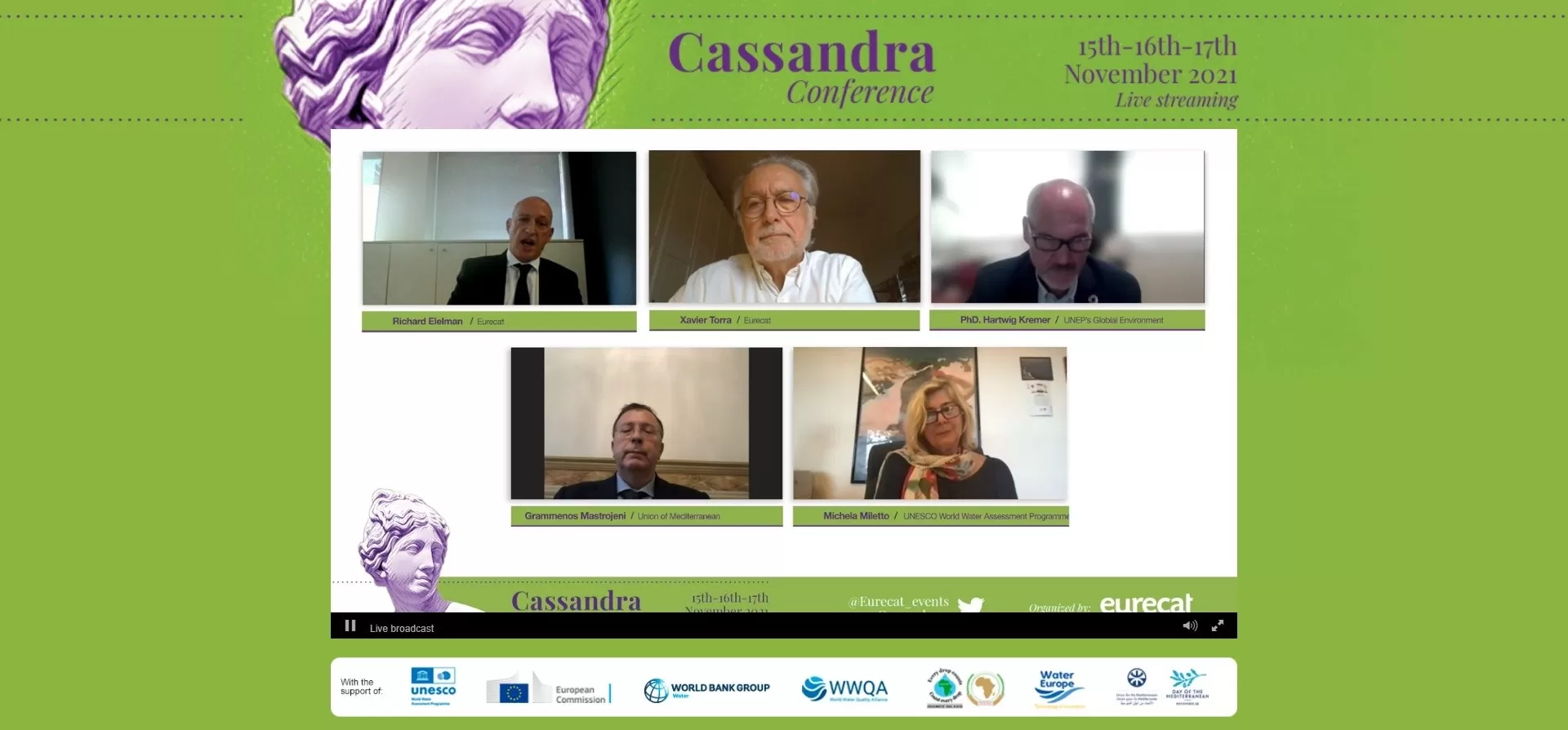
The first day of the international Cassandra conference, hosted by the Eurecat technology centre, warned of rising migration and conflict in the Mediterranean due to climate change, which the World Bank says has turned water scarcity into a trigger for growing involuntary displacement and economic and social inequalities.
In her talk, Esha Zaveri, senior economist at the World Bank, presented the “Ebb and Flow” report which examines the connections between water, migration decisions and economic development. The study’s conclusions include that water shortages lead to five times more migration than floods and it estimates that 21 million people in the Middle East and North Africa will have been forcibly displaced by the end of 2020.
The Cassandra conference was also addressed by Wolfgang Cramer, coordinator of MedECC and author of the report “Climate and Environmental Change in the Mediterranean Basin”, which sets out the forecast of a regional temperature increase coming to 2.2º C by 2040.
Hartwig Kremer, the head of the United Nations Environment Programme’s Global Environment Monitoring Unit, argued that climate change “leads to an increase in climate-related disasters in which water is the main risk factor for wellbeing.”
Xavier Torra, Eurecat’s chair, noted “the need to engage all sectors of society in crafting and rolling out practical solutions to mitigate and adapt to the potential effects of climate change.”
Climate change “is completely altering the balance of interests on which an entire region is built,” added Grammenos Mastrojeni, the Deputy Secretary General of the Union for the Mediterranean in charge of Climate Action and Energy.
Meanwhile, Michela Miletto, the coordinator of UNESCO’s World Water Assessment Programme, stressed that scientific solutions for water, food, energy and other issues should shape policy and decision-making.
Climate change and migration flows
The centrepiece of the discussion on the first day of the international Cassandra conference was the direct effect of climate change on health and security and its impact on migration coupled with how this involuntary displacement is viewed in the social and political arenas.
“Even in the best case scenario, if we hit the Paris target of 1.5º C, it is expected that millions more people will have to migrate,” warned María Guevara, the International Medical Secretary of Médecins Sans Frontières.
Jeannie Sowers, Professor of Political Science at the University of New Hampshire, pointed out that “we often focus on the human impacts of conflict and climate change, but we should also be talking about the environmental impacts of conflict and climate change.”


