
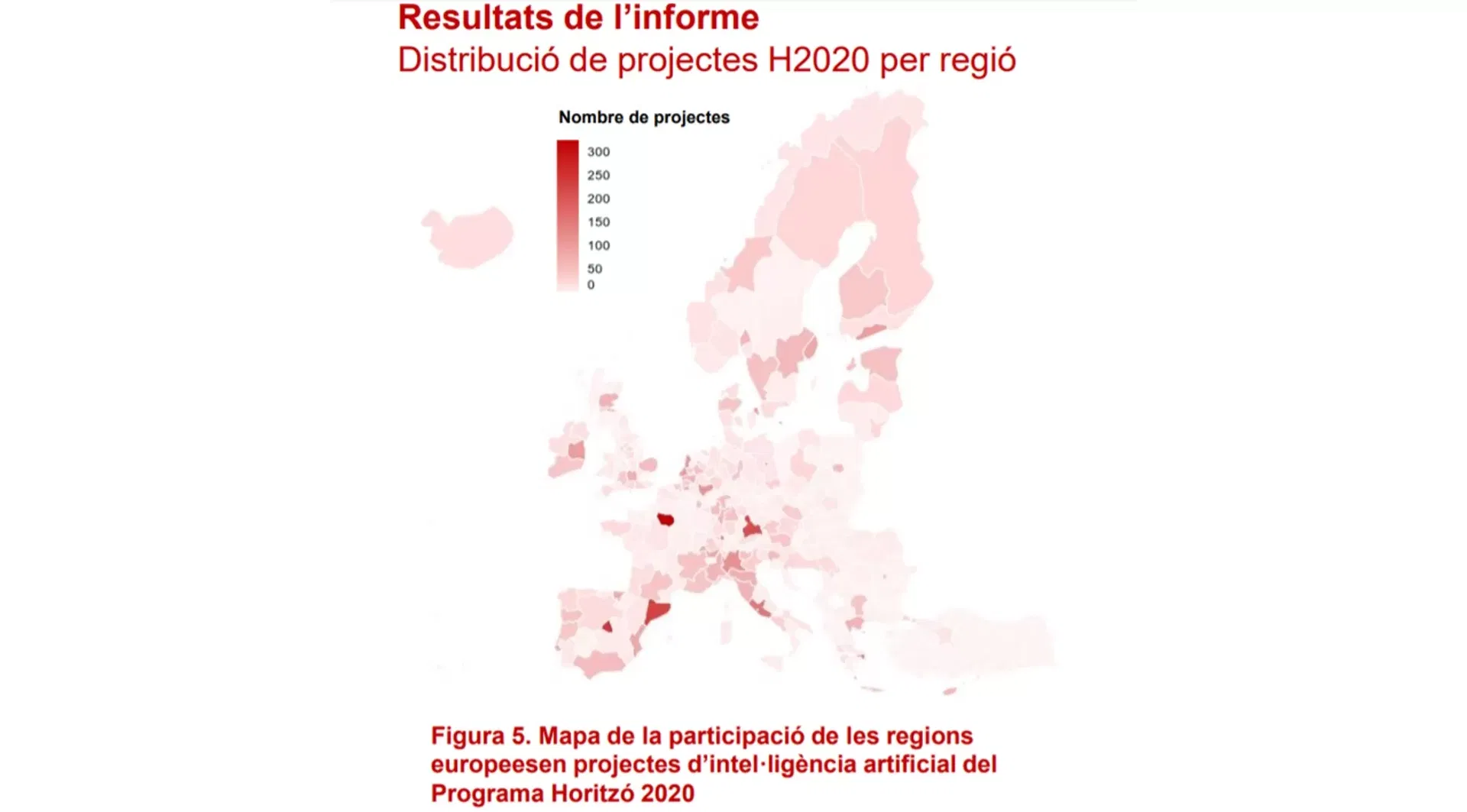
Catalonia has 228 artificial intelligence projects under the European Union’s Horizon 2020 programme, the EU’s flagship instrument for driving R&D and innovation. The ‘Analysis of Specialisation in Artificial Intelligence in Catalonia’ report shows that the region’s specialisation in this technology outperforms the European average.
The report has been drawn up as part of the RIS3CAT strategy and Artificial Intelligence Strategy of Catalonia.AI monitoring programme. It has been led by the Directorate General for Economic Development, Competition and Regulation (Ministry of the Vice-Presidency and Economy and Finance) together with the Ministry of Digital Policies and Public Administration and SIRIS Academic, which specialises in evaluating data-driven research and innovation policies.
The report was presented today at an online event hosted by the Centre of Innovation for Data tech and Artificial Intelligence (CIDAI) attended by Daniel Marco, Director General for Innovation and the Digital Economy; Tatiana Fernàndez, Head of the Economic Development Unit in the Directorate General for Economic Development, Competition and Regulation; Joan Mas, Director of CIDAI and Eurecat’s Digital Division, and the SIRIS Academic team.
The paper identifies and examines the key players conducting research and innovation in artificial intelligence in Catalonia, their cooperation networks and specialisation areas. It also reviews Catalonia’s relative standing compared to the leading European regions and the cooperation networks of Catalonia’s stakeholders in the EU and maps out how artificial intelligence helps address the challenges of society (SDGs) and industry.
The study has tapped innovative methodology to harness artificial intelligence techniques for automatic identification of projects based on a vocabulary of over 600 words setting out the scope of analysis and dumping the entire H2020 and RIS3CAT project databases.
The report shows that the 228 projects specialising in artificial intelligence in the Horizon 2020 framework put Catalonia in third place in the ranking of European regions in this programme where 11.3% of the projects have a Catalan partner. It additionally pinpoints 45 artificial intelligence projects out of the 683 RIS3CAT projects examined (6.66%).
The study further underscores the large number of artificial intelligence innovation and application projects in RIS3CAT’s sector areas. Artificial intelligence projects in Catalonia are primarily in the health industries (80 projects) followed by industrial systems (44), energy and resources (40) and sustainable mobility (33).
The report likewise shows the rise in the number of artificial intelligence projects between 2015 and 2019 (the last full year of the reporting period) and reveals a marked upward trend in annual output commensurate with the growing scientific, technological, business and public policy interest in this field.
Leading artificial intelligence organisations and businesses
Catalan organisations involved in the most artificial intelligence projects are the Polytechnic University of Catalonia (28 projects), the Barcelona Supercomputing Center (25), Pompeu Fabra University (25), the Eurecat technology centre (16) and the University of Barcelona (14).
Topping the list of businesses engaged in the most projects are PAL Robotics (5), Worldsensing (4) and Dexma Sensors (4). In relative terms, the organisations with the greatest specialisation in artificial intelligence projects are the Computer Vision Centre at 59%, the i2CAT Foundation at 24%, and the Telecommunications Technology Centre of Catalonia at 20%.
Global potential of artificial intelligence
By 2030, artificial intelligence will unlock an estimated additional USD 15.7 trillion to global GDP. This will be mainly from productivity gains due to process automation (including the use of robots and autonomous vehicles), increased workforce productivity driven by artificial intelligence (assisted intelligence and augmented intelligence) and savings in time and production costs as a result of these factors coupled with higher demand brought about by the availability of new, higher-quality and customised artificial intelligence products and services.
RIS3-MCAT Platform’s artificial intelligence module
The report is accompanied by the RIS3-MCAT Platform’s artificial intelligence module which is a crucial tool for the RIS3CAT’s entrepreneurial discovery process. It allows interactive exploration of actors, specialisations, challenges, international collaborations and artificial intelligence projects.
More information:
See the RIS3-MCAT Platform’s AI module here
See the ‘Analysis of Specialisation in Artificial Intelligence in Catalonia’ report here


