
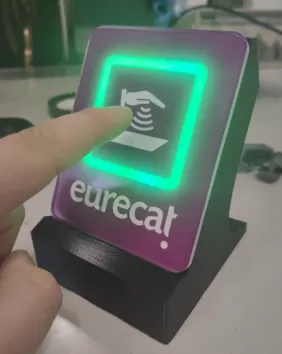
Habitat Cluster Barcelona, the Eurecat technology centre and partner firms Jung and Madersenia are running the ARIES (Artificial Intelligence Embedded in Surfaces) project to explore how to combine hybrid and flexible electronics with the application of gesture recognition technology through artificial intelligence (AI) in products for the habitat sector.
The project’s purpose is to tailor habitat sector products to the new needs identified in the market by turning them into smart objects which can be integrated into the Internet of Things (IoT) and Connectivity 4.0. It also caters to people’s current concerns about their interaction with everyday items by building in flexible electronics.
The Covid-19 pandemic has led to an unprecedented health crisis worldwide. Globalisation seems to have backfired and our way of life has been called into question: telecommuting versus face-to-face working, teleconferencing instead of travel and a new model of tourism. No one knows to what extent these changes will be lasting over time or whether this is the start of a new way of doing things. What is certain, however, is that for the time being we are up against new demands on all economic and social levels.
Against this backdrop, as a society we are rethinking the way we interact with the surfaces of commonly used objects in order to address the new need for utmost hygiene and avoiding contact. The idea is to prevent or minimise as far as possible the spread of microbes which might lead to humanitarian and economic disasters such as the one we have experienced worldwide.
This new imperative fits in with the fresh trends in the Habitat sector. The Habitat Trends Book 19/20 identifies seven under the ‘Everywhere Like Home’ tagline derived from the peace of mind and convenience we feel in our homes and extrapolating it to communal and shared-use environments where our comfort zone is noticeably smaller.
This project has been ongoing since May 2021 and is expected to be completed by March 2022. Two pilot tests are being run at two cluster partners, Jung and Madersenia, to embed artificial intelligence in their existing products and thus make it easier to create new ones with greater added value. Gesture recognition technology is under study in Jung’s plastic pushbuttons and Madersenia’s wooden furniture. It can be used to operate features of a room or space by, for instance, switching on, switching off or dimming lights, opening or closing blinds and turning the heating on or off. The news item photo shows the validation tests for the sensor in Jung’s pushbuttons at Eurecat.
The areas of application will be public places where there is a greater risk of infection (hospitals, hotels, offices, etc.) and the feasibility study specifically targets these sectors.
This project’s main expected outcome is validating the viability of developing smart surfaces with gesture recognition capabilities by integrating the flexible electronics and AI developed by Eurecat in the products of the two firms in the habitat cluster.
Another expected outcome of the project is to identify further opportunities for rolling out artificial intelligence in other businesses in the cluster through specialised industry workshops and knowledge transfer activities.
The project has been funded by the Ministry of Industry and Trade through the public call for grants for Innovative Business Cluster projects in 2021.


