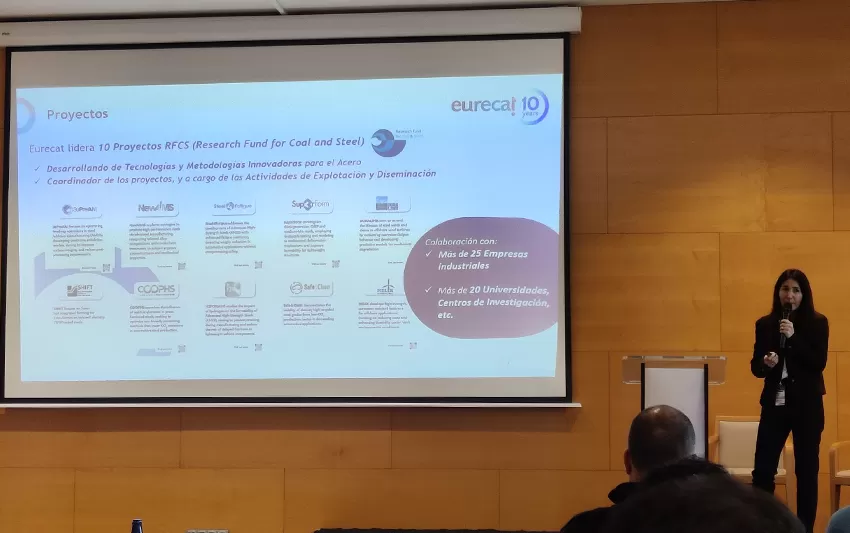
Within the framework of the COOPHS project, data-driven innovations in X-ray Absorption Spectroscopy (XAS) was presented at DataXAS 2026, the international symposium on Data-Driven Approaches in XAS, held on January 5–6 at ETH Zurich, Switzerland. DataXAS 2026 brough together leading experts in spectroscopy and data science to showcase the latest advances in machine learning and computational techniques applied to XAS.
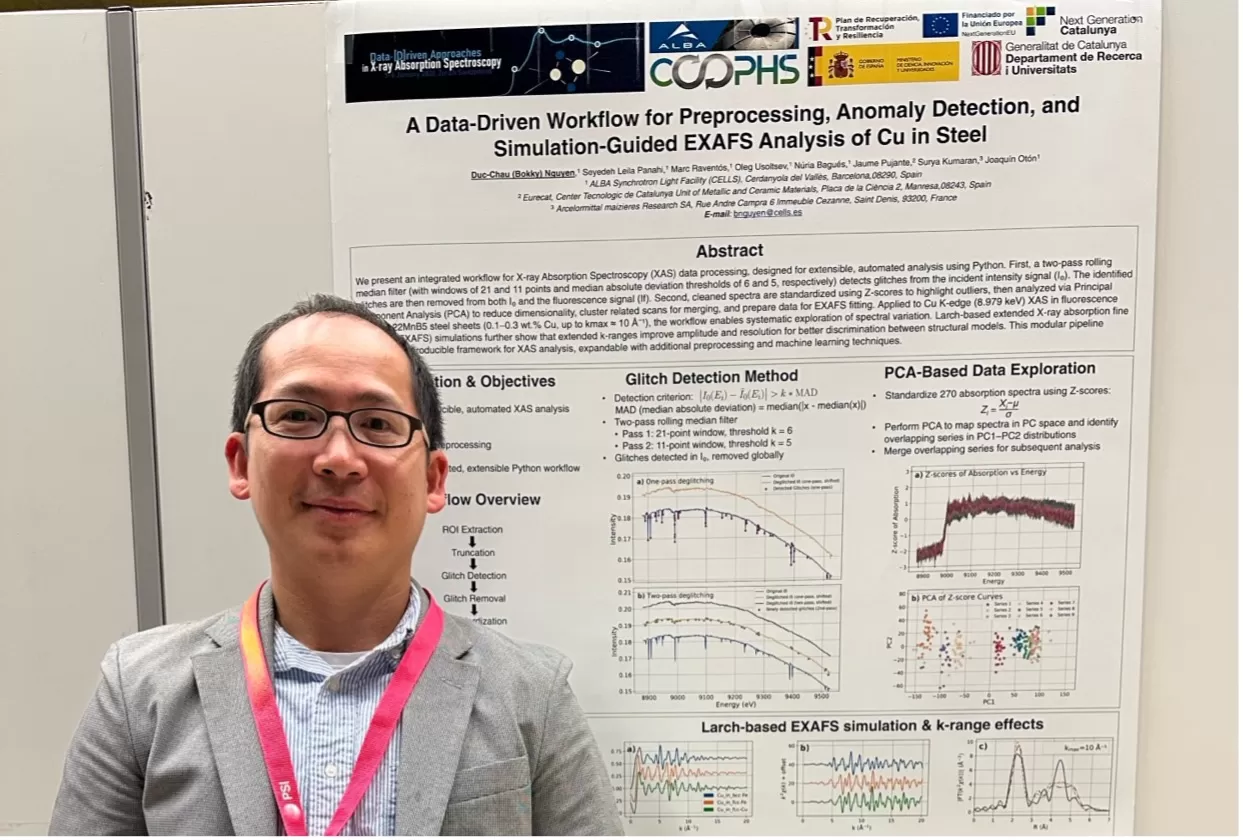
At the event, Bokky Nguyen, researcher at ALBA Synchrotron and COOPHS project member, presented the project with a flash talk and poster entitled “A Data-Driven Workflow for Preprocessing, Anomaly Detection, and Simulation-Guided EXAFS Analysis of Cu in Steel,” illustrating how advanced data analytics can enhance the reliability and interpretability of XAS experiments. As a project partner, ALBA-CELLS contributed methodological developments aimed at enabling more automated and reproducible spectroscopic analysis.
The presented work introduced an integrated, Python-based workflow for XAS data processing that addresses common challenges such as spectral glitches, scan-to-scan variability, and the need for systematic scan selection prior to EXAFS fitting.
Applied to boron steel sheets containing cooper residual elements, the workflow reduces data dimensionality, clusters related scans for optimal merging, and prepares the dataset for extended X-ray absorption fine structure (EXAFS) fitting. This COOPHS data-driven approach supports systematic analysis of subtle structural differences in industrially relevant materials and allows for a clearer discrimination between competing structural models.