
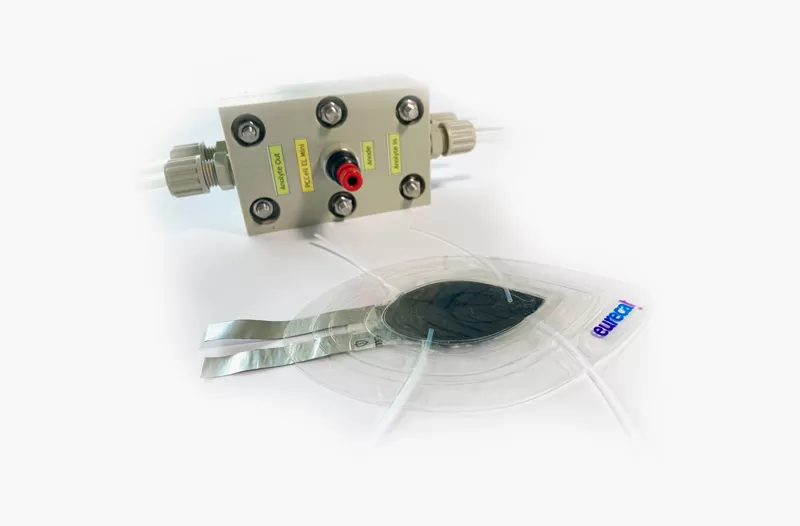
The Eurecat technology centre is taking part in the European LOPEC fair, the leading event for printed electronics, being held this week in Munich, where it is presenting the prototype of a flexible, lightweight printed device for producing green hydrogen, designed to reduce the impact and cost of the electrolytic cells usually used in this process.
The project, called eLEAF, has been developed ‘using much less material and through more sustainable and large-scale preparation methods’, explains Claudia Delgado, the head of the line in Eurecat’s Functional Printing and Embedded Devices Unit.
Specifically, as she notes, Eurecat’s team of researchers have turned ‘solid components of an electrolytic cell, such as charge collectors, which are usually metal plates; gas diffusion layers, which are usually carbon fabrics; and membranes, usually consisting of a polymeric sheet’, into ‘thin-layer printed elements’.
Using printed technology, ‘elements have been obtained with the same functionality as conventional parts, drastically reducing the impact and cost in comparison with the usual methods of preparing these electrolytic cells’, notes Cristina Casellas, the technology lead in Eurecat’s Functional Printing and Integrated Devices Unit.
Plastronics for the interior of smarter vehicles
Eurecat is also showing at the LOPEC fair a functional plastronics part developed with the company Industrias Alegre, designed for the interior of a cutting-edge vehicle, where various touch sensors and light elements have been integrated using printed electronics, ‘respecting the automotive industry’s demanding aesthetics’, says Paul Lacharmoise, the director of Eurecat’s Functional Printing and Embedded Devices Unit.
This technology ‘is strongly committed to reducing the weight of electronic elements and reducing and cheapening industrial assembly processes, paving the way for the new smart plastics revolution, and in line with the autonomous and connected electric vehicle trend, where the interior is conceptualised as a travel experience for the passengers’, adds Enric Fontdecaba, the director of Eurecat’s Plastic Materials Unit.
With its presence in this project, Industrias Alegre is seeking new ways to add value to the automotive industry. ‘We’ve always shared challenges with our customers’, says sales manager Mónica Alegre, and now, ‘with our foray into the field of plastronics, we’re looking for new solutions for the car of the future, but we want to do this with the best company. We want to generate synergies with companies that are experts in electronic design and turn into integrators of these solutions by taking advantage of our expertise in different plastic injection technologies’.


