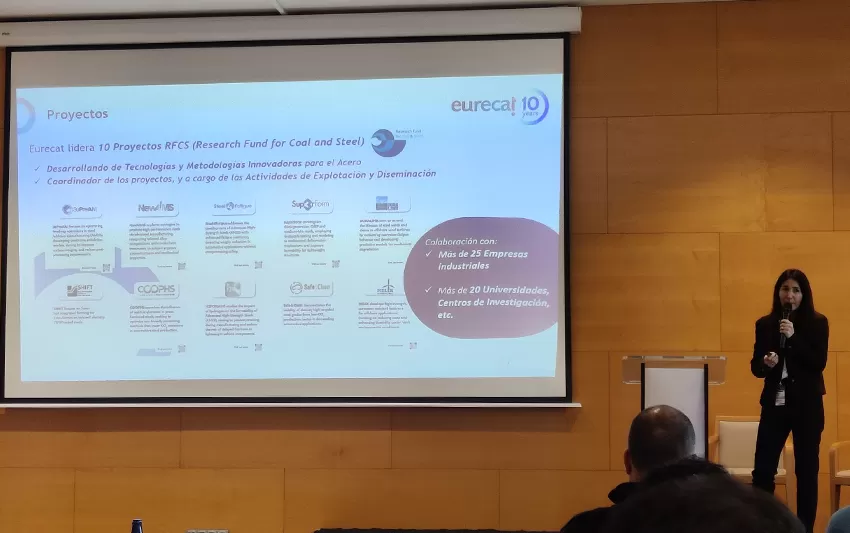
The European DURALINK project contributed to Sea Tech Week 2026 with a dedicated workshop addressing corrosion, fatigue and structural integrity challenges in offshore renewable energy systems.
On 7 October 2026, the DURALINK project organised the workshop “Durability and Structural Integrity of Materials in Offshore Renewable Energy Systems” in Brest, France, as part of Sea Tech Week 2026.
The event was jointly organised by the French Corrosion Institute, Eurecat and the National Institute of Ocean Technology (NIOT), bringing together researchers and technical experts to exchange knowledge on improving the durability and reliability of materials exposed to demanding marine environments.
The workshop provided an opportunity to present the DURALINK project’s research activities and discuss technological challenges associated with corrosion, fatigue and material degradation in offshore renewable energy infrastructure.
The session opened with an introduction to DURALINK by Younès Demmouche (ENSTA) and Marie Minola (French Corrosion Institute), who also chaired the workshop and presented the project’s objectives and research approach.
Addressing durability challenges in offshore applications
The technical programme featured five expert presentations covering different aspects of material performance and structural integrity.
Krista Van Den Bergh (ArcelorMittal/OCAS) discussed the durability of thermally sprayed zinc-aluminium (Zn-Al) alloy coatings for floating wind turbine applications, addressing protective solutions for steel structures exposed to corrosive marine conditions.
Amadeu Concustell Fargas (Eurecat), DURALINK project coordinator, presented “Optimization of steels and welds properties for offshore applications”, focusing on the performance of steel welds and high-strength steels used as structural materials and in the mooring systems of floating offshore wind turbines.
The programme also included a presentation by Laure Civier (ENSTA) on synthetic mooring ropes for floating offshore wind turbines, exploring an alternative material solution for offshore anchoring systems.
Extending the discussion to other ocean energy technologies, Trishanu Shit (NIOT) addressed the structural integrity and fatigue performance of deep-sea water intake high-density polyethylene (HDPE) pipes, while S. S. Prakash Kumar Lagudu (NIOT) presented material integrity considerations for heat exchangers in open-cycle Ocean Thermal Energy Conversion (OTEC) plants.
Together, the presentations highlighted the importance of understanding material behaviour under long-term mechanical loading and environmental exposure to support safer and more durable offshore renewable energy systems.
By bringing together experts from research institutions and industry, the DURALINK workshop at Sea Tech Week 2026 contributed to knowledge exchange and the dissemination of research approaches addressing these challenges.