WEEI

RECIBIL

2020-09-08T07:55:35+02:00

Increase of the circularity of spent batteries from electric and hybrid vehicles and development of new identification protocols to give a new use for second-life batteries. The RECIBIL project promotes and increases the circularity of spent batteries from hybrid and electric vehicles and develops new identification protocols for second-life batteries, with life cycle analyzes. The project aims to help the different decision-maker agents (car manufacturers, second-life battery users, recycling companies, etc.), in the end-of-life management process of the electric vehicle fleet that is expected to be deployed at European and global level in the coming years, [...]

SMART FACTORY

2021-11-18T11:39:43+01:00

Development of advanced monitoring algorithms, with the challenge of working with complex, large, heterogeneous and interdependent systems, incorporating aspects such as energy efficiency, environmental impact and security with high resolution, from the data provided by new sensors and actuators. The Smart Factory project is based on the modelling and optimal operation of machinery and industrial processes, with the aim of increasing the flexibility and adaptation of monitoring and control systems, improving energy efficiency in industry and promoting fault diagnosis and predictive maintenance of industrial plants (health aware control). Thus, the project focuses on three main lines [...]

ULTIMATE

2020-09-08T08:02:59+02:00

Creation of synergies between industry and water services to promote the efficient management of resources and value products, through the concept of circular economy. The ULTIMATE project promotes synergies and symbiosis between the industry and public water services with the aim of improving water management, creating economic value and increasing sustainability through the valorisation of resources within the water cycle. Wastewater has a key role as a reusable resource and also as a carrier for energy and components that can be extracted, treated, stored and reused. With the innovative concept “Water Smart Industrial Symbiosis” (WSIS), the [...]

RIBAS

2020-09-08T07:59:06+02:00

Development of a new decontamination technology for highly contaminated soils by petroleum hydrocarbons and heavy metals. The RIBAS project is under the POSIDON initiative which has the objective of promoting innovation for the decontamination of polluted sites and soils. In the framework of the project, 5 European procurers have launched a Pre-Commercial Public Procurement (PCP), which is a transnational multiple-sourcing contract concerning R&D services aimed at steering the development of sustainable and cost-effective solutions for the decontamination of highly contaminated soils, preferably in-situ, whilst comparing/validating alternative solution approaches from various R&D providers. Eurecat, through its Water, [...]

WATER-MINING

2020-06-05T13:06:00+02:00

Large-scale demonstration of water-smart and efficient management systems to promote a circular economy and society. The WATER-MINING project aims to aims to be an example for social embedding of innovative solutions in a wide spectrum of technology applications. WATER-MINING provides examples for real-world implementation of the Water Framework Directive to help the transition to Circular Economy, incorporating EU Green Deal packages. The demonstrations will integrate innovative technologies developed by partners and from previously funded EU projects. These novel technologies will be demonstrated in different pilots realised in Spain, Cyprus, Portugal, Italy and The Netherlands to reclaim [...]

SEA4VALUE

2020-06-26T10:03:41+02:00

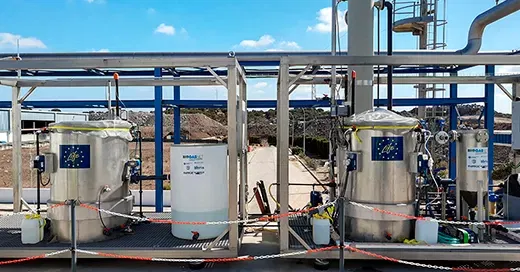
Radical innovations to recover minerals and metals from seawater desalination brines. The SEA4VALUE project, coordinated by Eurecat, has the objective to develop a Multi-mineral Modular Brine Mining Process (MMBMP) for the recovery of valuable metals and minerals from brines produced in sea-water desalination plants (SWDP). The innovation promoted by the project improves the economic feasibility of well-established concentration and crystallisation processes (capacitive deionisation, membrane crystallisation, bipolar electrodialysis, multi-effect distillation) while performing research on innovative materials to develop the next generation separation processes enabling the production of raw materials from seawater brines. Eurecat, which participates to the [...]

SunCoChem

2024-10-07T09:09:56+02:00

Development of a photoelectrocatalytic tandem reactor (TPER) to manufacture chemical products from renewable energies based on CO2, water and sunlight, integrating the capture and conversion of CO2 in a single dispositive. The SunCoChem project, led by Eurecat, aims to provide the chemical industry with an alternative to produce oxo-chemicals without using raw materials derived from carbon or oil. Based on the single-unit CO2 capture and conversion architecture to design a self-sufficient device, SunCoChem's innovation manages to reduce costs, reduce CO2 emissions and improve the efficiency of converting energy from sunlight to chemicals. In addition, the project-driven [...]

COBRA

2020-05-26T13:54:44+02:00

A novel Cobalt-free Lithium-ion battery technology that overcomes many of the current shortcomings faced by Electrical Vehicle (EV) batteries via the enhancement of each component in the battery system in a holistic manner. The COBRA project develops a new unique battery system that merges several sought-after features, including superior energy density, low cost, increased cycles and reduced critical materials. The proposed Li-ion battery technology will be demonstrated at TRL6 (battery pack) and validated on an automotive EV testbed. The innovation promoted by the project ensures an easy adaptation to production lines and scale-up to contribute to [...]

LIFE HIDAQUA

2020-05-15T08:02:09+02:00

Sustainable water management to decrease the emission of pollutants from industry and the exploitation of alternative water sources, preserving the quality of natural water bodies and the quantity of natural drinking water resources. The LIFE HIDAQUA project addresses water management in high water demanding industries, by tackling environmental problems such as the depletion of natural drinking water sources; the low ecological and chemical status of natural water bodies and the burdening of the environment with the discharging of liquids and the landfilling of wastes from water treatment processes. The proposed water treatment system is based on [...]

FATIGUE4LIGHT

2022-08-24T07:32:34+02:00

Development of new tests and computer simulation methodologies with the aim of predicting the life of the electric vehicle chassis components and selecting optimal materials. The Fatigue4Light project works on the application of new materials adapted to chassis requirements, such as advanced high-strength steels, special automotive stainless steels, high-strength aluminium alloys and metal-polymer hybrid materials. The innovation of the project manages to reduce the weight of the vehicle chassis up to 30% compared to more innovative solutions and up to 40% compared to some existing applications, taking into account aspects of eco-design and circular economy. The [...]

LIFE BIOGASNET

2022-02-25T10:44:51+01:00

Development of a profitable, sustainable and environmental friendly biogas purification system. The use of biogas for energy production is increasing due the lower cost and associated reduction of greenhouse gas (GHG) emissions compared to fossil fuels. To use this biogas as a fuel is needed to remove the hydrogen sulphide contained through desulfurization technologies that present high environmental impacts. LIFE BIOGASNET project develops an innovative technology, based on biological processes, since it couples a biotrickling filter to a nitrification bioreactor, with the aim to promote the use of biogas as a sustainable energy source. Technology of [...]

SPHERE

2022-11-16T11:16:16+01:00

The SPHERE platform, based on the BIM building standard, implements the Digital Twin concept by creating a service ecosystem to improve and optimize the energy management of residential buildings throughout their life cycle, from design, construction and operation. The SPHERE project promotes more sustainable construction processes with the purpose to reduce costs, environmental impact and achieve a greater energy efficiency of building. SPHERE platform presents ICT solution tools that accompany customers, developers, builders and designers during the design, manufacturing, operation and end of the useful life of buildings. The platform creates a dynamic and participatory environment that [...]

Go to Top